Monday, 5 July 2021

The Best Things About... The Phantom Menace

Many people like to rank the Star Wars films in order of preference, or ask others for their top three, top five, etc. Inevitably these lists are held up against one another, the upshot being that the things people like the least are often discussed the most.

I've never cared too much for ratings or lists. Every Star Wars film is - in some way - fantastic. Here we celebrate the best things (I think) about each of them, starting with The Phantom Menace.

Style and Feel

The Phantom Menace is for me the Star Wars film that feels closest to the Original Trilogy. There's something about the feel of it, the way the story is allowed room to breathe compared to the more hectic later installments, that rekindles that feeling of Episodes IV, V and VI. The Sequel Trilogy achieves this a little from time-to-time, but no film has managed it throughout its length as well as Episode I.

While the visual effects were moving with the times - replacing more and more practical effects - their prevalence compared to Episodes II and III is much more constrained and is more in keeping with the originals.

What we end up with is an occasionally imperfect film that feels like it came from a perfect place.

The Podrace

Ah, the podrace. Every so often a film will pause its narrative mid-way through for a well-crafted set-piece. Sometimes a great film will deliver a stunning set-piece, showing you something you've never seen before and driving the story forward.

The more you watch it, the more you realise the race itself is pretty straightforward. But it's the little details and the breadth of what is happening that elevates it to something more: Tusken Raiders taking pot-shots at the pods, the vivid personalities of the colourful racers, the sound design of the crafts - especially Sebulba's hammering engines overtaking the mix as he bears down on Anakin.

It's a masterclass in how to cinematically present a set-piece.

Lucasfilm / Starwars.com

Naboo

We've been to a lot of planets and locations in the Star Wars galaxy, but few can match the spectrum of Naboo. The splendour of the Nubian cities and their architecture, the sweeping plains, the gorgeous lake country, the vibrant life-filled swamps, the entire beautiful hidden Gungan culture, the porous planetary core teeming with monsters... It's difficult to sum up Naboo in one breath, let alone one paragraph.

Naboo is a colourful world that seems to invite exploration. It's my number one wished-for location in SWTOR, or any open-world Star Wars adventure game to be honest.

Lucasfilm / Starwars.com

That Lightsaber Duel

It's a testament to the evolving choreography of the Star Wars series over the decades that it's possible to look back at this Obi-Wan, Qui-Gon, Darth Maul duel and see deficiencies in it. But even if it does look at times a little staged (particularly compared to the fluidity we've been spoilt with in the Disney era), the speed and ferocity are astonishing.

The Original Trilogy and The Phantom Menace established the high-point of lightsaber battles that actually told a story without words (something later encounters have struggled a bit with).

Qui-Gon's patience mixed with Obi-Wan's youthful adrenaline tells you everything you need to know about this fight and its impact on galactic history - the importance of which has been so eloquently described by Dave Filoni in Disney Gallery: The Mandalorian (well worth a watch on Disney+).

Friday, 2 July 2021

Game Changer

Battlefront II is a beautiful, expansive game and it's hard to believe it's now over three-and-a-half years old. It won me over from a rocky launch, evolving into an online / offline shooter that lets you take part in hectic battles across some of the most iconic Star Wars locations. For most of its life, however, it has also been a torturous multiplayer experience for the casual player.

I consider myself 'ok' at video games. If I put in the time and effort I believe I can even become 'quite good' at them. Playing against other human beings in a game like Battlefront II, however, is very different to wandering around on your own in something like SWTOR, and if you're not prepared for it the experience can be pretty traumatic.

Battlefront II's major mode at launch, Galactic Assault, has a breadth that just about allows less-experienced or more casual players to stay on the periphery of the action and have a good time, mostly. Any interaction with the objectives or the player enemy team in force, however, and it can quickly descend into: spawn, run forward for a few seconds, get killed, respawn, repeat.

I'll admit that Battlefront II fell out of favour with me for more than a year in recent times, largely because of this dynamic. I didn't have the time or inclination to learn in detail what I was doing wrong to compete with the really good players out there. I just wanted to jump into a Star Wars environment and shoot some stuff! The offline single player modes were a little basic compared to the scope of something like Galactic Assault, so that didn't really float my boat either.

Imagine my surprise, then, when I decided to give the game another try and found a new mode: Co-Op! (Note I am very much behind the times here and understand Co-Op is no longer 'new'!)

I had assumed, knowing nothing about it, that Co-Op would be four human players going up against map-based objectives. A bit like the multiplayer Strike mode but with enemy AI. Imagine my further surprise when I realised Co-Op was basically a mash-up of the large-scale Supremacy and Galactic Assault modes, with large teams of AI enemies and allies and four human players (all on the same side) thrown into the middle of it.

I'd finally got exactly what I wanted out of this game: the ability to dive in, not have to remember exactly how to play and have fun running around and shooting at things. Perfection.

The AI isn't super-intelligent, but it's come a long way since the launch of the game, and is suitably impressive to have fun with. And the introduction of your human teammates means there's still an element of strategy to be had: it's entirely possible to be defeated if you don't work as a team and end up splitting your energies.

I would say that Co-Op is good and demanding fun with a well-orientated team, but can be extremely difficult if the team is less experienced or divides its forces and becomes overwhelmed by the huge numbers of AI opponents that spawn.

No longer do I have to watch from the side-lines for fear of dying every few seconds...

Importantly, even in defeat Co-Op mode is exciting. It's fun to go down being swamped by twenty enemies. It's not fun being sniped by a single, jumping, rolling, too-much-time-on-their-hands human player in Galactic Assault... (Can you hear the bitterness?)

So Co-Op has completely changed how I look at Battlefront 2 and given me something of a renaissance with the game. It's the mode I now almost exclusively play. Every so often I dip into Supremacy or Galactic Assault just to see if I get a decent game, but I'm soon back in Co-Op mode. This is what I'm here for: relaxed, engaging fun. I don't want to be able to play the best at Battlefront 2, I just want to be able to play.

Monday, 21 December 2020

A Finale and A First Step

Spoilers ahead for The Mandalorian Chapter 16

I'm not one for rushing out prose on recently released Star Wars content. I prefer to let the words sit in draft for a time, until my thoughts have fully formed and I can release something of value. (Hence why I have so many draft versus published posts!) But The Mandalorian has had a profound effect on me, especially the season two finale. I feel compelled to get my thoughts out of my head as quickly (for me) as possible!

It's easy to get swept along with the extra-universe content for the show, especially online speculation, discussion and reviews. It can at times feel like we're all supporting a sports team that competes every Friday for glory, and we're not always on the same side. Sometimes it's good to step away from the noise outside the series and simply let a show like The Mandalorian wash over you. Such was the hype surrounding the series two finale that I really tried my best to approach it in this manner. And as a result I was not disappointed by a single thing, and very nearly brought to tears...

I'm loving the pacing the show has developed - a no-nonsense approach that throws the viewer in to exactly what the filmmakers want us to see, when they want us to see it. Boba Fett? Get him in episode one. Perhaps they'll gradually tease Ahsoka into Chapter 13? Nope, white lightsabers within two and a half minutes. Who should answer Grogu's Tythonian call? Surely not the Luke Skywalker? Yep, and you know what? Let's not recast, let's build on existing technology and show him how we'd imagine him to be. Oh, and let's show what he can do in his youthful prime, cutting through Dark Troopers with the green-bladed lightsaber that we'd only seen tentatively spar with skiff guards and Vader way back in 1983. And lastly, R2's here too for good measure. Wow.

It would have been easy for season two to simply be a greatest hits of cameo appearances. Too many more and perhaps it would have become dull and distracting from the central story, but I think just the right balance has been struck - making best use of the time our visiting heroes are present.

The final scene between Din, Grogu and Luke is one of, if not the, most emotionally charged moments in all of Star Wars. That this can be achieved between a man who rarely takes his helmet off and a puppet is testament to the incredible writing and direction of the series.


So Din and Grogu take their first steps away from each other. I have no doubt that they will be reunited again and - in the manner that the show keeps surprising us - possible sooner than we might think.

Nonetheless, there are so many paths in which the show could head. Will Grogu indeed stay with Luke? What of the fate of the Darksaber and the unintended dynamic that now exists between Din and Bo-Katan?

Have we indeed finished reading The Book of Din Djarin, at least for the moment? I doubt it. The Book of Boba Fett (introduced in the post-credits sequence) is now confirmed to be a separate series from The Mandalorian. For the few days that I considered the Boba Fett angle might be part of the same show, I was intrigued by the possibilities. Could we then have moved on to the The Book of Bo-Katan and have returned to the Din / Darksaber storyline?

As much as I want to see Din's story continue, such an approach does appeal to me. A complete collection of Mandalorian stories that weave in and out of each other. With the announcement that other Disney+ series will interlace with The Mandalorian, such as Ahsoka, we seem to be seeing multiple threads of the same story starting to be told - within and without The Mandalorian itself. The possibilities appear endless.

On Grogu, I'm excited to see how his story continues. It struck me that perhaps R2 and Grogu have indeed met before, a (human) lifetime ago in the Jedi Temple of the Old Republic. The prospect of perhaps seeing Grogu's early years in flashbacks is mouth-watering.

What of his future with Luke? Will the training of Grogu be one of the first failures Luke experiences, setting him on a course to become the disillusioned figure we see in The Last Jedi? That would certainly help get The Child back to where I'm sure the audience considers he belongs: with Din.

This is the most exciting Star Wars storytelling perhaps... ever?

Friday, 18 September 2020

Now I'm An Achiever

I've never really bothered with the achievements aspect of SWTOR. But every now and again I get into a bit of a lull in my gameplay and I go searching for something to do. Recently, in one such lull, I stumbled across a forum post where someone was complaining that there was nothing to do at endgame. Another player replied, retorting that there was 'never a shortage of things to do' in the game - providing a long list of activities the original poster might like to try.

The list really struck me and the more I thought about it the more I realised that, 'Yes, there's never a shortage of things to do!' Among the long list was working on achievements.

Recently I've dug into trying to complete some and I've had a lot of fun. The best ones are of course the ones with rewards: be it a title or a few extra Cartel Coins. The legacy titles in particular have attracted me, and stumbling across the title reward Galactic Explorer, I knew that if I only ever completed one more achievement it had to be this one!

A couple of days later (and a lot of exploring on Nar Shaddaa - that place is a maze) and I'm now a bona fide explorer!


I had fun chasing the achievement. I don't think I'm turning into a completionist particularly, but I may dig into the achievement list more often now.

Friday, 28 August 2020

Return to the Skies

I hadn't played the Galactic Starfighter component of SWTOR in any serious way since it was released in the 2.x update cycle. Recently I've been looking to give one of my level 75 characters a particular focus, especially for Conquest, so I decided to really dig into GSF at last.

Two factors helped me with this. The first is that GSF progress and rewards are tied to each individual character, rather than your Legacy, so it makes sense to have just one Republic and one Imperial character focus on it. Secondly, the Daily and Weekly quest rewards are quite generous with Tech Fragments, presumably to encourage more people to play the mode.

I couldn't just pick up and play, though. My head canon needed placating first... Every character needs a good RP reason to do something!

So the first couple of hours of my GSF experience were spent getting just the right flightsuit costume sorted...


Meet Gale Rantilles, my Commando Combat Medic and part-time starfighter pilot. Until I learn how to properly heal in group content she'll be earning me Tech Fragments in GSF.

Queuing up, I was initially a little concerned at the long wait time for a GSF match. On a Saturday night, getting on for midnight, I got only one match in 45 minutes of queuing. If that was a representative rate of match-pops it may take more than a week to complete the Weekly quest! Subsequently queuing between 9.30 and 10.30 in the evening provided no such problems, so I might have to make GSF the first stop of the evening.

I was prepared for my first dozen or so matches to be pretty brutal. Most guides I've read highlight the steep learning curve and the high death rate until you manage to equip your ship a bit better, and my experience followed this path.


The first few battles were tough. A lack of experience and a low-spec'd ship resulted in a lot of early exploding. Then, about seven matches in, losing at a Domination game, something turned. The enemy team seemed to suddenly spread themselves too thin. I managed to capture a satellite, then another. The enemy responded, but it wasn't enough. We won by a handful of points, coming from several hundred behind. It was great, and the sense of achievement brilliant. 'I really like Galactic Starfighter!', I thought.

Like all PVP it's tough when you're losing. Even tougher when you're being hammered. Early on, you'll start to think it isn't worth it. But then a match will come up that changes your fortunes and your mind.

Swtorista has just started a new series on the basics of GSF and, as always, her content is highly recommended.

Happy flying!

Thursday, 13 August 2020

The Long and Short of It

Let's talk about scale and suspension of disbelief. How, in my opinion, scale is one of the central tenants that makes Star Wars great. And why disregarding it can damage storytelling.

"For over a thousand generations the Jedi Knights were the guardians of peace and justice in the Old Republic."

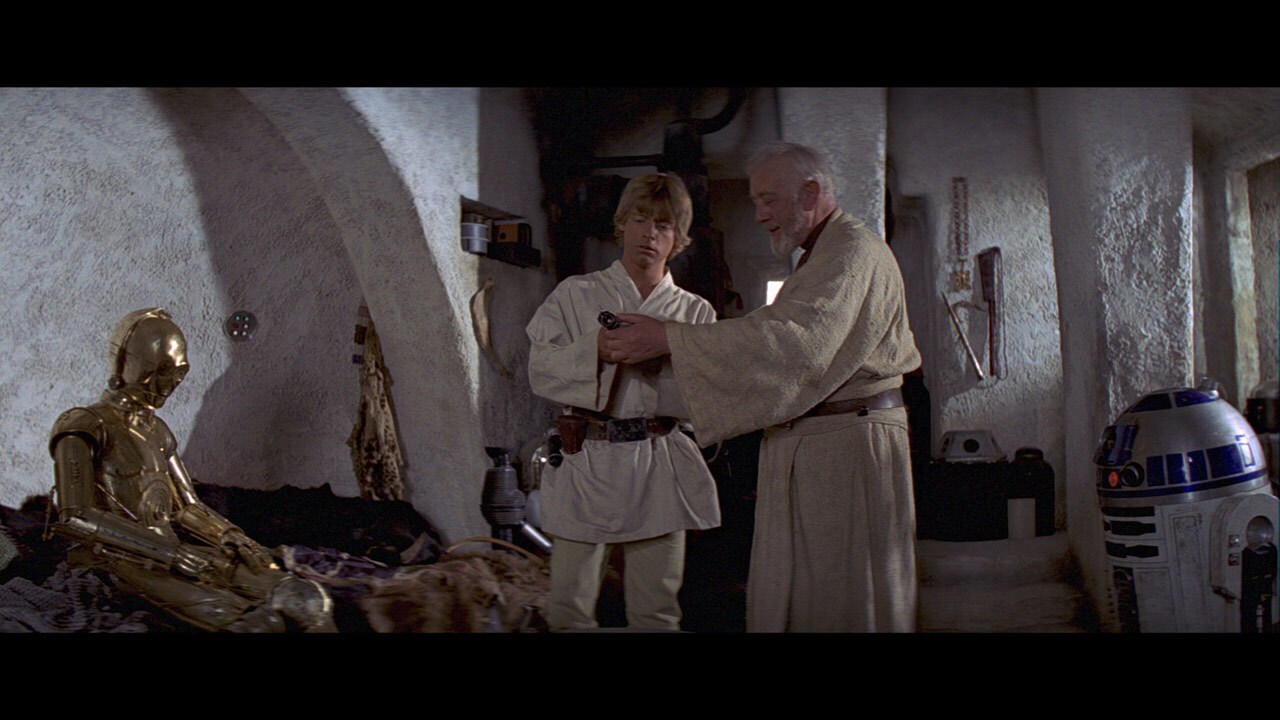
Wow. As a child, hearing Obi-Wan Kenobi state that in A New Hope, my first thought was, 'How long is that?' Because it sure sounded like a long, long time.

(Taken as 25 years per generation, which is a pretty standard measure, that's obviously 25,000 years - the figure I always had in my head growing up with the Expanded Universe.)

As a young Star Wars fan, my mind started to fill with possibilities. This was a huge amount of time, and the potential for stories within it mind-boggling.

Obi-Wan relates to Luke about the Old Republic and the Jedi (Lucasfilm / Starwars.com)

As I learnt more and more about Star Wars I realised that the Old Republic Obi-Wan spoke of didn't cover the entire galaxy - not even close. Nor did the Galactic Empire that took its place, although it appears to have enlarged somewhat from its democratic predecessor. This was fascinating: there were whole areas of the galaxy simply labelled 'Wild Space' or the 'Unknown Regions'. Even the 'Deep Core', relatively close to many of the most important locations from the films, remained largely unexplored.

This was great. I loved that the Star Wars I knew, as rich and diverse an experience for the senses as it was, was just a tiny moment in time across a handful of locations in a sea of stars. Scale, whether it's temporal or geographical, is very important: the breadth, depth and complexity of the galaxy is what makes Star Wars so appealing to me.

I don't want the galaxy to be small. I want it to be big. Very big. The bigger the better! Scale is good for storytelling. The more space, the more stories, the greater variety we're going to get.

Temporal and geographical contraction

Come the 21st Century and some cracks started to appear. Palpatine's comment in Attack of the Clones that the Republic had 'stood for a thousand years' jarred with everything I had grown up knowing. It was subsequently retconned that he was merely referring to the Republic as it had been since the Ruusan Reformations a millennia prior, so as not to contradict Kenobi's earlier (or later, in-universe!) comments. Bullet dodged - it turns out Mr Lucas hadn't contracted the age of the Republic by a factor of 25.

Wherever that particular discontinuity came from, sometimes scale is sacrificed for narrative purposes. A more cruel commentator would call this merely the absence of more creative writing, but I understand why it's sometimes necessary. There is no excuse, however, for handling it badly.

Rogue One (one of my very favourite Star Wars films) began a series of more recent geographical contractions: a squadron of X-Wings can leave Yavin IV and effect an attack on Eadu in the time it takes for Jyn Erso to climb a ladder... Believable perhaps if the two systems were right next to each other, but they're not... Not even close. Rogue One just about gets away with this, I think, without breaking the suspension of disbelief.

However, the sequel trilogy is more guilty of these sort of tropes. The arrival of First Order and Resistance forces to Takodana in The Force Awakens being a good example. Perhaps they were all just in the neighbourhood?

Flitting from one planet to another as quickly as the sequels do could be argued as expanding the geographical scale of the galaxy, but it also reduces the temporal impact. The original and prequel trilogies do a much better job of sticking with a few well-defined and explored locations that the audience really has time to get to know. In the sequels we're off to somewhere new before we can really learn to love somewhere.

Narrative driving in-universe mechanics is absolutely fine (The Last Jedi does this a bit better), but there has to be a balance, otherwise the entire set-up becomes simply unbelievable. And on a couple of occasions I think the sequels take this a little too far.

The future of the past

Fast forward to the last few months and much discussion has focused on the pre-prequel era of Star Wars content. With seemingly such a large history to explore, would we be transported to the Old Republic on screen? Would we see a range of stories spread across those 25 millennia?

With The High Republic announcement, we have learnt that the content will be set a mere 200 years before The Phantom Menace, 'when the Galactic Republic and the Jedi Order are at their zenith'. I'll be honest, I was surprised at that. 200 years? That doesn't feel like too much time in the Star Wars universe.

The High Republic content will cover 'a time of galactic expansion in the Outer Rim.' This also struck me as a little odd. Surely the Outer Rim would be very well settled a mere two centuries before the fall of the Republic?

I'm getting twitchy about scale again... And these fears are probably unfounded. The announcement stresses that, 'This period on the Star Wars timeline will not overlap any of the filmed features or series currently planned for production', which of course leaves the door open for exciting adventures set further back in time. The High Republic is a publishing sphere, so despite my reservations over the timeframe, there's still thousands of years of Republic history for Lucasfilm to delve into.

Star Wars: The High Republic Jedi
Lucasfilm / Starwars.com

Parallels

I think some of my unease comes from wanting Star Wars to be completely different to our own understanding of history. It's difficult to not draw parallels between certain aspects of Star Wars and the real world experiences of the human race, and in particular American history. Indeed, George Lucas has spoken himself on the subject.

It's hard not to draw a parallel between The High Republic and the American West: the dominant power pushing out into a (for them) unexplored frontier. As the announcement states, 'expect there to be rich tales of exploration; charting out the galaxy, meeting new cultures, and discovering what pioneer life in the Outer Rim was like.'

None of this is necessarily bad. Parallels are fine, and of course you want the audience to relate on some level to the story. But when they cross a certain line the whole suspension of disbelief can come crumbling down.

When we run parallels too close, or make the galaxy smaller because it suits our story, we start to lose the essence of what makes the story great in the first place. Star Wars has always been about, 'Wow, I've never seen anything like that before.' Not, 'Ah, that feels a little like...'

And you certainly don't want people sitting in the cinema thinking, 'That doesn't feel like it could happen...'

When it comes to Star Wars, bigger, longer and unfamiliar are generally better.

Thursday, 2 July 2020

A Little Can Go a Wrong Way

A recent, relatively insignificant, change to the user interface in SWTOR sparked a cacophony of outrage on some of the more popular forums and outlets.

A new UI element, the 'Galactic Guide', was introduced to replace the old Social Bar and it was, well, weird. Not only does it not match the look and feel of the rest of the UI, it also can't be customised in the same way the rest of the screen items can. The fact that it introduced some bugs into the way the UI is used and contains a prominent link to the game's real-world money marketplace (the Cartel Market) only added insult to perceived injury. This was seemingly especially the case among some subscribers, who objected to being overtly pushed towards the cash shop when they already pay their dues. Such players are always likely to be the most vocal, and rightly so, but also I suspect in the minority of numbers compared to the casual, free-to-play and preferred status players, who EA need to drive towards the Cartel Market.

I'm not particularly concerned with the content of the Galactic Guide - it doesn't serve any useful purpose for me. Rather I'm more disappointed at the minimised appearance:

The old Social Bar, which could be minimised into the form above

The new one, which, er- cannot

The episode got me thinking. Not so much about the element itself (and yes I think it's odd and incredibly annoying), but about what seemingly tiny details can upset the balance of a game and drive players into incandescence.

The answer, I hope, is that the vast majority of players really do care a great deal about the game. They are invested in it (emotionally and financially) and want the best possible experience BioWare can give them. When there is a perceived breach of that developer-player trust (or where something is obviously just poorly done) these players take a hit: their world, their Star Wars experience, is now a little diminished. And that can hurt. SWTOR, like all of Star Wars, is pure escapism for many people. When something comes along to jog us out of that reality we feel it personally.

This is why when something a developer introduces is in the spirit of the game, open and honestly communicated there will likely not be a problem. It's the feeling of forced-direction and poor execution that riles most, I suspect, not that there's now an extra link to the Cartel Market.

As implemented, the Galactic Guide is a jarring item in an otherwise immersive experience. And anything that jolts players out of their game-reality is going to have a disproportionate effect, no matter how small that item is.

Developers beware: even the smallest details can go wrong. Think about how the truly invested players might react - in the end, they're the ones that will still be here years down the line. While the most vocal, they're probably the ones that love your game the most, too.